
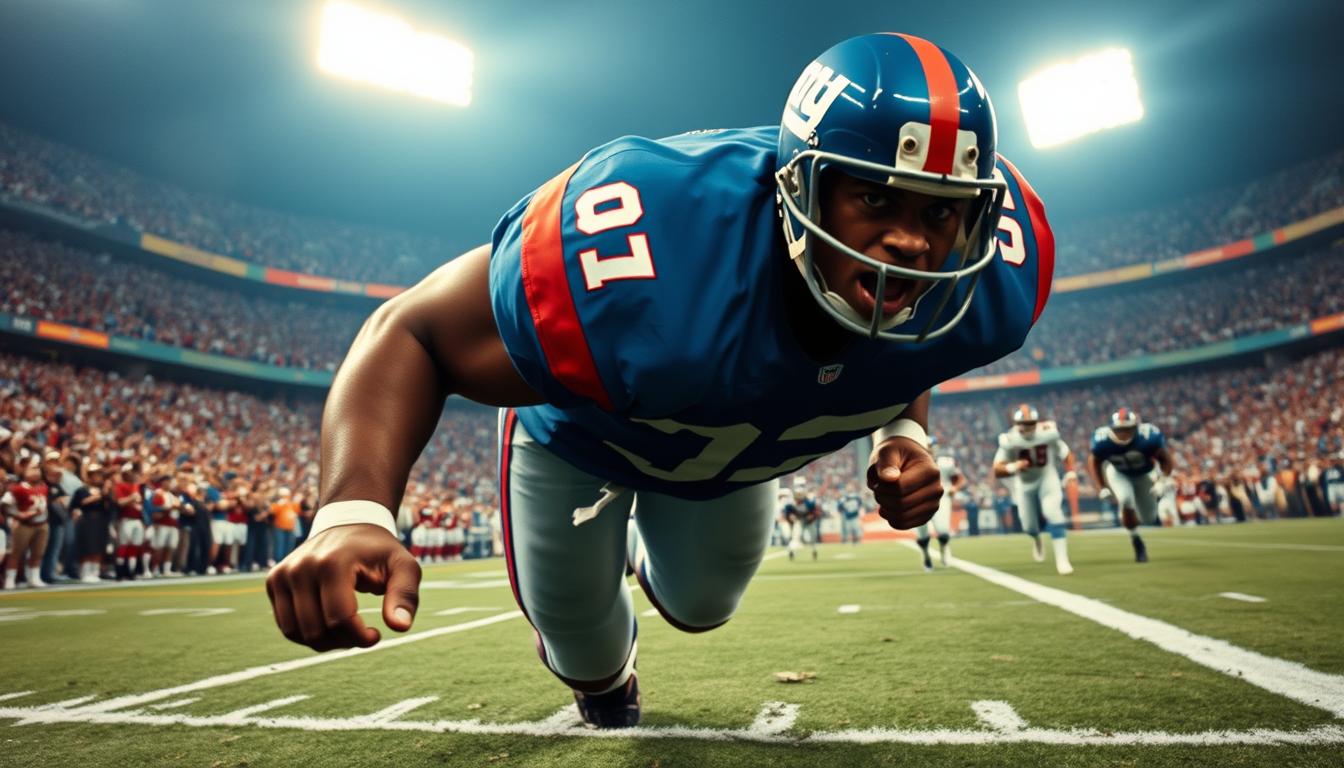
Some athletes don’t just play the game; they rewrite its rules. In the history of the NFL, few figures stand as tall as the legend Lawrence Taylor. His arrival created a clear dividing line in professional football.
Wearing number 56 for the New York Giants, this player redefined the very idea of defensive power. His impact echoes the way Muhammad Ali transformed boxing or Michael Jordan reshaped basketball. The sport was fundamentally different after he stepped onto the field.
This Lawrence Taylor Legacy is not just about sacks or tackles. It’s about how one man’s unique talent forced the entire league to adapt. Offensive schemes had to be torn up and rebuilt because of his unprecedented speed and ferocity as a linebacker.
We will explore how his dominance created new positions, changed team economics, and instilled a genuine fear in opponents. This is the story of how a single defenseive force altered the NFL forever.
Key Takeaways
- Lawrence Taylor is widely considered the most transformative defensive player in NFL history.
- His career created a “before and after” moment for the sport, similar to other iconic athletes.
- He single-handedly revolutionized the linebacker position with his unique blend of size and speed.
- Taylor’s dominance forced offensive coaches to completely redesign their strategies.
- His influence led to the increased strategic and financial value of the left tackle position.
- In 1986, he achieved the rare feat of a defensive player winning the NFL MVP award.
- The modern game’s defensive philosophies still reflect innovations sparked by his play.
Introduction to Lawrence Taylor’s Era
Professional football stood at a crossroads in the early 1980s. Offensive innovations threatened to overwhelm traditional defensive approaches. West Coast schemes were revolutionizing passing attacks across the league.
The New York Giants desperately needed change. Their 1980 season saw them allow 425 points. The team finished with a disappointing losing record that year.
Giants GM George Young recognized the special talent available. He declared before the draft, “Taylor is the best college linebacker I’ve ever seen. He’s bigger and stronger than Butkus was.” This assessment proved remarkably accurate.
| Season | Points Allowed | Defensive Ranking | Key Addition |
|---|---|---|---|
| 1980 | 425 | 27th in NFL | No significant changes |
| 1981 | 257 | 3rd in NFL | Lawrence Taylor drafted |
| Improvement | -168 points | +24 positions | Immediate impact |
Linebacker play before this time followed traditional patterns. Players were slower and more reactive. They focused on gap control and zone coverage responsibilities.
The player from North Carolina transformed everything immediately. His rookie season produced unprecedented results. He became the first to win both Defensive Rookie and Player of the Year honors.
Transformation of the NFL Landscape
Football strategy faced its most dramatic overhaul in decades as an unprecedented talent took the field. Lawrence Taylor didn’t just improve defensive schemes—he forced the entire game to evolve. Offensive playbooks became instantly outdated against his revolutionary approach.
The linebacker combined rare physical attributes never ever seen at his position. At 6’3″ and 237 pounds, he possessed both the speed to chase running backs and the power to overwhelm blockers. This unique blend created a defensive prototype that changed scouting priorities across the league.
Defensive coordinators immediately began searching for “the next Lawrence Taylor.” This shifted how teams evaluated players for the defense. The modern emphasis on edge rushers emerged directly from his impact on the league.
Offensive coordinators dedicated extra blockers to contain him on every play. They designed formations specifically to avoid his side of the field. These adjustments limited strategic options and changed how the game flowed for all players.
Teammates recognized his unique abilities, nicknaming him “Superman.” Quarterback Phil Simms noted, “on the pass rush, he’s an animal. He’s either going to run around you or over you.” His individual dominance elevated the entire New York Giants team to championship caliber.
The Blind Side Evolution and Left Tackle Revolution
The quarterback’s vulnerable side became a strategic focal point thanks to one dominant force. Right-handed quarterbacks drop back looking right, leaving their left side exposed. This blind spot became Lawrence Taylor’s hunting ground.
Positioned as a right outside linebacker, his explosive speed created nightmares for opposing teams. Pittsburgh Steelers legend Terry Bradshaw recalled the terrifying experience: “He dang-near killed me. He kept coming from my blind side and just ripped my ribs to pieces.”
The economic landscape shifted dramatically. Left tackles became premium assets as franchises realized protection was paramount. Salaries skyrocketed for these crucial players.
| Position | Pre-Taylor Importance | Post-Taylor Value | Salary Increase |
|---|---|---|---|
| Left Tackle | Standard lineman | 2nd most important | 400%+ growth |
| Right Tackle | Equal to left | Secondary priority | Modest growth |
| Quarterback | Franchise player | Required protection | Investment priority |
The 1985 incident with Washington’s Joe Theismann demonstrated the stakes. His career-ending injury highlighted the catastrophic consequences of failed protection.
Innovative coaches like San Francisco’s Bill Walsh assigned their best blocker, guard John Ayers, specifically to shadow Taylor. Standard schemes couldn’t contain this unprecedented threat.
Every team in the football league had to adapt. The search for elite left tackles became universal, changing draft strategies and free agency priorities forever.
Tactical Impact: Unleashing LT’s Speed
Bill Parcells and Bill Belichick crafted defensive masterpieces around one extraordinary talent. The head coach and his brilliant coordinator recognized traditional linebacker duties would waste their star’s unique gifts.
They designed schemes that prioritized attack over reaction. Instead of reading and dropping into coverage, their defense unleashed immediate pressure. This revolutionary approach transformed the giants defense into an aggressive force.
One game against St. Louis Cardinals revealed the genius. Lawrence Taylor ignored his coverage assignment and sacked the quarterback. When Parcells confronted him, Taylor famously replied, “Well, we better put it in on Monday, because that play’s a dandy.”
The head coach appreciated this independent thinking despite their clashes. Parcells privately praised Taylor’s “mean streak” to veterans. This productive tension drove both men to excellence.
Specific innovations included reducing pre-snap reads and designing explosive stunts. The coach positioned his star to exploit offensive weaknesses immediately. Every play maximized his unprecedented speed.
| Responsibility | Traditional Approach | Parcells/Belichick Innovation | Game Impact |
|---|---|---|---|
| Pass Rush | Controlled, read-based | Immediate, aggressive attack | Quarterback pressure |
| Coverage | Zone responsibilities | Minimal, rush-focused | Forced quick throws |
| Run Defense | Gap control | Penetration priority | Backfield disruption |
| Pre-snap Reads | Complex analysis | Simplified, attack-focused | Faster execution |
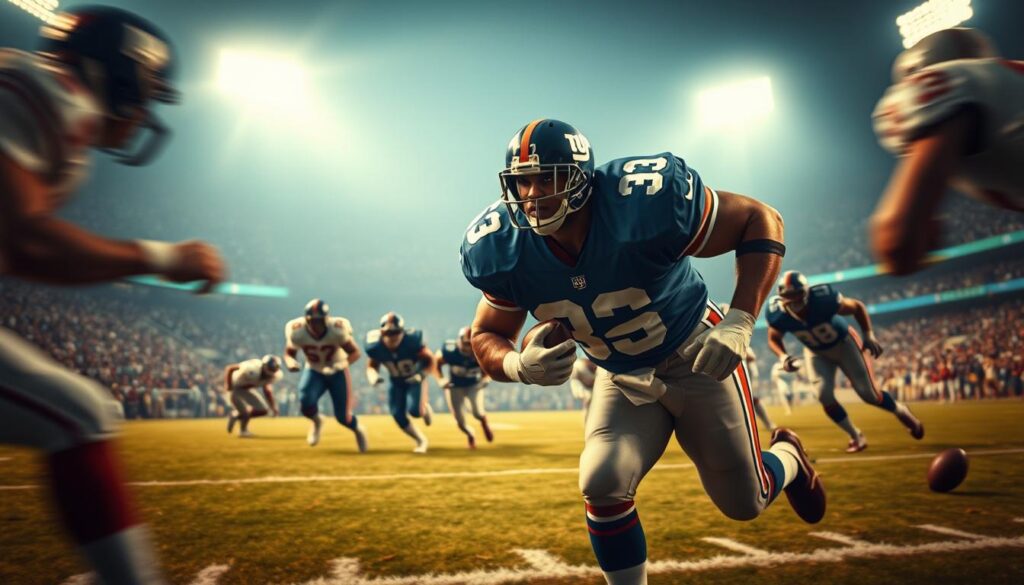
These tactical changes created the legendary “Big Blue Wrecking Crew.” The entire team benefited from the defensive dominance. Their innovative approach delivered two Super Bowl championships.
The coach‘s understanding of exceptional talent shaped football history. Every game showcased their brilliant defensive designs. The giants defense became the blueprint for modern pressure schemes.
Lawrence Taylor Legacy: Redefining Defense
Defensive greatness in the NFL has a single benchmark that towers above all others. The player from the New York Giants created a new standard that still defines elite performance today.
His unprecedented achievement as a defensive MVP places him in exclusive company. Only one other defenseive player has ever earned this honor typically reserved for offensive stars.
Three Defensive Player of the Year awards demonstrate sustained dominance. This record stood alone for decades before being matched by modern stars.
Selection to both the 75th and 100th Anniversary All-Time Teams confirms timeless impact. The football league recognizes his contributions remain relevant across generations.
Before this linebacker, the position focused mainly on run stopping. After his career, elite linebackers became measured by their ability to disrupt entire offensive schemes.
His transformative effect compares to sports icons like Muhammad Ali and Michael Jordan. Each redefined what was possible in their respective sports.
Modern defensive coordinators still use principles developed for his unique talents. Every first-round edge rusher represents teams searching for similar impact.
The New York Giants legend established defense as an exciting, game-changing force. His influence continues shaping how teams build championship rosters today.
On-Field Achievements and Milestones
Individual honors typically favor offensive stars, but one defender broke through with unprecedented recognition. The 1986 season saw this player become only the second defensive player in NFL history to win MVP.
His 20.5 sacks led the league that year. The Giants finished 14-2 and dominated their playoff opponents. They crushed the San Francisco 49ers and Washington before winning Super Bowl XXI.
This remarkable year capped an incredible rookie campaign. In 1981, he achieved something no one has done before or since. He won both Defensive Rookie and Defensive Player of the Year honors.
Sustained excellence defined his career. Ten consecutive Pro Bowl selections from 1981-1990 demonstrated his consistency. Eight First-team All-Pro honors showed he dominated his position multiple times.
Two Super Bowl championships bookended his prime. Super Bowl XXI in 1986 and XXV in 1990 gave his team the ultimate prize. Each championship run featured memorable playoff games against tough opponents.
His career statistics tell part of the story: 1,088 tackles and 142 sacks. But numbers alone cannot capture his impact on every game. Opponents built entire game plans around containing him.
Key playoff battles against the Chicago Bears and Los Angeles Rams showcased his clutch performance. His presence transformed the Giants from struggling franchise to champion team.
Psychological Warfare: Instilling Fear in Opponents
Beyond sacks and tackles, the true measure of this player’s impact was the genuine fear he instilled in every opponent. Quarterbacks approached each game against the Giants with a unique sense of dread that fundamentally altered their performance.
Hall of Famer Terry Bradshaw captured this terror perfectly: “He dang-near killed me. I just kept saying, ‘Who is this guy?’ He kept coming from my blind side and just ripped my ribs to pieces.” Even veteran players who had faced brutal defenses recognized this as a different level of threat.
The 1985 injury to Joe Theismann became a defining moment. The compound fracture ended a quarterback’s career on national television. This event seared into the consciousness of every player and coach.
Lawrence Taylor’s emotional response revealed his competitive nature rather than malicious intent. He screamed for paramedics and has never watched the play. His reputation for playing through extreme pain added to the mystique.
Offensive coordinators spent disproportionate practice time preparing special schemes. Quarterbacks released the ball faster and made more check-down passes. This mental hesitation created tangible advantages that translated directly into wins.
The psychological dominance established a template for future defensive stars. Instilling doubt and forcing conservative play became as valuable as physical skills in determining game outcomes.
Cultural Legacy: Chaos Off the Field, Discipline On the Field
Few athletes embody such stark contrasts between professional discipline and personal chaos. The same focus that made this player revolutionary during games often vanished away from the stadium.
Substance abuse began early in his career. The legend lawrence admitted using cocaine during his second NFL year. A 1988 suspension followed failed drug tests.
Retirement brought deeper struggles. Three jail times resulted from drug possession attempts. The New York Giants organization grew deeply concerned about his safety.
Team executives took unusual measures. After a near-fatal car crash, GM George Young doubted he would reach age 30. The franchise insured his life for $2 million.
| Aspect | On-Field Behavior | Off-Field Behavior | Impact |
|---|---|---|---|
| Discipline | Precise, controlled violence | Reckless, unpredictable | Contrasting public perception |
| Substance Use | None during games | Escalating addiction issues | Career suspensions |
| Legal Issues | Clean record | Multiple arrests | Damaged reputation |
| Longevity | 13-year Hall of Fame career | Life-threatening incidents | Organizational concern |
A 2010 arrest marked his lowest point. Statutory rape charges led to guilty pleas for sexual misconduct. Registration as a sex offender permanently altered his public image.
Between 1998 and 2009, he claimed sobriety. This period included work as a sports commentator and actor. It represented an effort to rebuild his life.
The Lawrence Taylor story forces difficult questions about separating athletic achievement from personal conduct. His legacy remains complex for New York sports fans and football historians alike.
Economic Shifts: Changing Scouting and Salaries
Contract negotiations and salary structures were forever altered by the economic impact of a single defensive player’s unprecedented performance. The entire football league witnessed a fundamental restructuring of how teams valued defensive talent.
Left tackle salaries skyrocketed from modest offensive line wages to become the second-highest paid position after quarterback. This market transformation directly resulted from the need to protect against dominant pass rushers.
The New York Giants star’s own contract dealings set new precedents. In 1983, a dispute with the USFL’s New Jersey Generals involved a $1 million loan from Donald Trump. The resolution brought a six-year, $6.2 million deal that reflected his unique value.
Scouting departments completely reorganized their evaluation priorities. They began emphasizing speed and pass-rushing ability over traditional size metrics. Before the 1981 draft, 26 of 28 general managers said they would select Lawrence Taylor first overall.
Teams throughout the league, including franchises like Tampa Bay, began investing heavily in defensive positions. They recognized that quarterback pressure provided better returns than coverage players alone.
This economic revolution proved that transcendent defensive players could deliver championship returns. The lesson continues driving modern sports personnel decisions across the football world.
Defensive Tactics: Shaping Game Strategies
The NFL playbook underwent a radical rewrite to counter a single, unstoppable force. Offensive and defensive coordinators alike were forced to abandon decades of conventional wisdom.
The giants defense, under its innovative head coach, capitalized on this. They built schemes that prioritized immediate pressure over complex coverage. This defense led to simpler, more aggressive pass rush packages.

Offenses had to respond with drastic measures. Bill Walsh, the brilliant San Francisco 49ers coach, made a historic adjustment. He assigned guard John Ayers to shadow the star linebacker, a tactic that became standard.
Formations changed league-wide. Teams kept tight ends and running backs in to block. They designed quick-release pass plays to get the ball out before pressure arrived.
| Traditional Strategy | Taylor-Era Innovation | Modern Equivalent |
|---|---|---|
| Complex blitz packages | Individual pressure creation | Elite edge rusher focus |
| Coverage-first defense | Immediate quarterback disruption | Pressuring with four rushers |
| Standard line blocking | Dedicated “shadow” blocker | Chip blocks and double teams |
Specific games highlighted his tactical impact. Against the St. Louis Cardinals, an improvised pass rush was so effective it was added to the playbook. Versus the New Orleans Saints, he dominated despite a severe injury.
These innovations form the bedrock of modern NFL strategy. The concepts developed to contain this one player remain fundamental today.
The Giants’ Defensive Transformation
One player’s arrival transformed a struggling defensive unit into the feared ‘Big Blue Wrecking Crew’ that dominated the NFL. The New York Giants defense allowed 425 points in 1980, ranking among the league’s worst.
The giants legend Lawrence Taylor changed everything immediately. His rookie season saw points allowed drop to 257. The team improved from 4-12 to 9-7 in just one year.
Taylor anchored the legendary ‘Crunch Bunch’ linebacking corps. This group included Carl Banks, Gary Reasons, and Hall of Famer Harry Carson. They formed one of football’s most dominant units.
The New York Giants built consistent success around their defensive foundation. Records improved to 10-6 in 1984 and 1985. The 1986 championship season saw a dominant 14-2 record.
| Season | Team Record | Points Allowed | Playoff Result |
|---|---|---|---|
| 1980 | 4-12 | 425 | No playoffs |
| 1981 | 9-7 | 257 | First round exit |
| 1985 | 10-6 | 299 | Lost to Chicago Bears |
| 1986 | 14-2 | 236 | Super Bowl XXI Champions |
Playoff performances showcased the defense’s dominance. The 1985 run included victories over the Los Angeles Rams and San Francisco 49ers. The 1986 playoffs saw them outscore opponents 66-3 before winning the championship.
This defensive identity persisted through Super Bowl XXV in 1990. The culture established by the giants Lawrence Taylor created sustained success. The franchise honors him as their greatest player of all time.
Legacy Reflected in Modern NFL
Today’s NFL landscape operates on principles forged by one man’s unprecedented defensive dominance. The sport’s current strategic DNA reflects adaptations made necessary decades ago.
Left tackles now command $20+ million contracts as second-highest paid players. This economic reality stems directly from the vulnerability exposed during those transformative years.
Scouting departments prioritize edge rushers with rare size-speed combinations. Teams like the Philadelphia Eagles and Tampa Bay consistently draft linebackers hoping to find similar impact.
Defensive coordinators employ aggressive pressure schemes developed to maximize elite pass rushers. These tactics create one-on-one matchups rather than complex blitz packages.
Offensive game plans still incorporate quick passes and maximum protection. Formations account for dominant edge threats across the league.
The 2022 New York Giants campaign featured Taylor passing a jersey to Saquon Barkley. This symbolized how his influence spans generations in professional football.
Current head coach Brian Daboll carries Bill Belichick’s coaching lineage. This connection maintains tactical philosophies born from that revolutionary era.
Conclusion
The measure of a true sports revolution lies in its enduring impact across generations of competition. Lawrence Taylor didn’t just dominate games; he permanently altered football’s strategic landscape.
His thirteen seasons with the New York Giants established the gold standard for defensive excellence. The legend Lawrence Taylor forced offensive innovations, reshaped economic priorities, and created the modern pass-rushing archetype.
Today’s NFL still operates on principles his career established. Teams continue searching for the next transformational linebacker who can change the game.
This comprehensive analysis provides valuable insights into how one exceptional player can redefine an entire sport. Feel free to return to this guide as the definitive resource on this transformative football figure.
The Legacy Continues
Explore More Icons:
- The Unbeatable Mind: Tom Brady’s 7 Strategies to Dominate Any Challenge – Discover how the offensive GOAT mastered the game that LT once revolutionized.
- Michael Jordan: The Untold Secrets Behind His Unstoppable Legacy – If you enjoyed LT’s dominance, see how MJ brought that same “killer instinct” to the court.
Deep Dive & Multimedia:
- Lawrence Taylor’s Hall of Fame Profile – Official stats and the legendary career summary at the Pro Football Hall of Fame.
- NFL Films: The Best of Lawrence Taylor – Watch the raw power and speed that changed the game’s defensive geometry.
- The Evolution of the Blind Side – An analytical look at how LT’s arrival created the modern Left Tackle position.